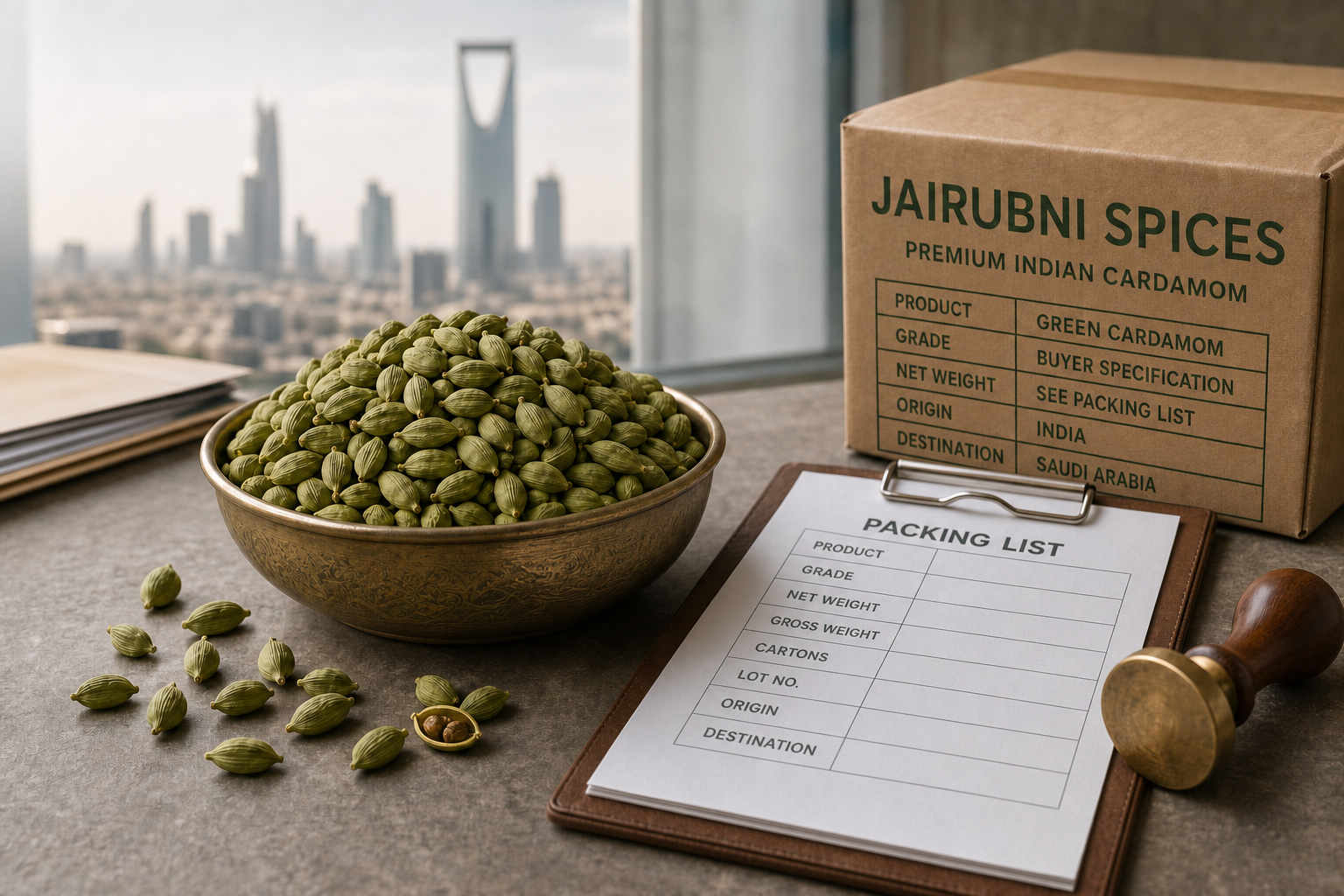
Start with the importer, not the shipment
Smooth Saudi clearance begins before cardamom leaves India. The commercial buyer, Saudi importer, exporter and customs broker should agree on the product identity, intended use and document set before packing starts.
The Saudi Food and Drug Authority (SFDA) states that the importer must have an SFDA account, register imported food items and hold a Commercial Register that includes food trade. Imported products must meet the technical regulations and standards applied in the Kingdom. That makes importer readiness the first gate—not a task to solve after the cargo reaches Jeddah or Dammam.
Ask the Saudi buyer to confirm the exact importing entity, product-registration status, intended use and port of entry. Retail-ready jars, foodservice packs and bulk material going into a licensed factory can follow different labelling and handling paths. The approved product name, HS classification, invoice description and label should tell the same story.
This guide is a procurement checklist, not legal or customs advice. SFDA and Gulf standards are updated. The Saudi importer and customs broker should verify the current product-specific requirements in the SFDA systems before dispatch.
The clearance pathway at a glance
These stages overlap. Label artwork may depend on the registered Arabic product name; laboratory scope may depend on the product form and buyer specification; and shipping documents must match the final packed quantities. A controlled pre-shipment file is safer than collecting documents independently at the last moment.
Who owns each clearance task?
Use this responsibility matrix during supplier onboarding. It is deliberately operational: each row ends with evidence that both parties can confirm before the container or air shipment is released.
| Requirement | Saudi importer | Indian exporter | Confirm before dispatch |
|---|---|---|---|
| Importer and food-item registration | Maintain the importing entity’s SFDA account and product registration. | Provide accurate manufacturer, product and pack information. | Importer confirms active status and registered product identity. |
| HS code and description | Confirm classification with the customs broker. | Use the agreed code and product description consistently. | Code, form and description match across the file. |
| Commercial invoice | Provide consignee, billing, VAT and delivery details. | Issue the invoice with agreed Incoterm, weights and values. | Importer and broker approve the draft. |
| Certificate of origin | Confirm format and any legalization or preference need. | Arrange issuance through the applicable Indian authority. | Origin, exporter and invoice references agree. |
| Product and batch documents | Define Saudi and internal quality requirements. | Provide specification, lot identity and agreed test evidence. | Results are complete and tied to the shipped batch. |
| Arabic label review | Approve Arabic content and registered product details. | Share final dieline, English source copy and pack data. | Signed artwork approval is retained. |
SFDA describes documentary checks, identity checks, physical examination and possible laboratory testing at border inspection posts. A consignment may be rejected at any of these stages. See the SFDA imported-food requirements.
Product, testing and packaging decisions
“Green cardamom” is not a complete buying specification. Procurement should define the product in a way that can be inspected and repeated: whole pods or seeds, size profile, visual tolerance, moisture target, aroma expectations, foreign-matter tolerance, pack format, batch size and intended use.
1. Match the grade to the application
Large, visually uniform pods are often selected for premium retail presentation and Arabic coffee applications. Industrial grinding, tea blending or extraction may place more value on aroma, seed fill and cost-in-use than on pod diameter alone. Review our commercial cardamom grades guide and quality evaluation guide before turning a visual preference into a purchase specification.
2. Agree the laboratory scope in writing
SFDA’s clearance guide identifies general regulations covering microbiological criteria, pesticide residues, contaminants and toxins. That does not mean every consignment requires an identical certificate of analysis. The correct scope depends on classification, current rules, inspection risk and the buyer’s own quality programme.
Before sampling, agree which laboratory, methods, analytes, limits, report language and lot definition will be accepted. Common buyer discussions include moisture, microbiological status, pesticide-residue panels and contaminants. Do not request a generic “full test” without naming the market-specific standard and acceptance criteria.
3. Build the pack around the route and use
Specify inner food-contact material, net weight, number of inner packs per master carton, tamper evidence, palletisation and shipping marks. Bulk food-manufacturing material and retail-ready packs have different operational needs. Compare bulk cardamom packaging options, then agree the final pack with the importer before label production.
Labels and shipment documents must agree
For prepacked food, the SFDA clearance guide points to GSO 9 for labelling. It states that food labels and accompanying information must be in Arabic; when another language appears alongside Arabic, the information must match. Exact mandatory fields and presentation should be reviewed against the current regulation and product registration.
A practical cardamom artwork review normally checks the product name, ingredient declaration, net quantity, country of origin, batch or lot code, production and expiry information where applicable, storage instructions, packer or manufacturer information, and Saudi importer details. Claims such as “organic,” quality marks or Halal logos should appear only when the required evidence supports them.
The 2025 SFDA clearance guide describes a limited route for food imported for manufacturing purposes, including licensed food factories and certain restaurant preparation uses: an undertaking through the Fasah platform may allow English labelling in the circumstances described by the guide. Treat this as a controlled exception for the Saudi importer to validate—not a general exemption.
The commercial invoice, packing list, certificate of origin, bill of lading or airway bill, product registration and physical labels should use matching product names, pack counts, net and gross weights, lot references, consignee details and country of origin.
Handle Certificate of Conformity as a live requirement
India’s Spices Board published a Saudi-specific circular on Certificate of Conformity arrangements for small-cardamom consignments and later issued clarifications. Because certification programmes and approved conformity-assessment routes can change, the importer and exporter should confirm the current applicability, approved body and sampling procedure for the specific shipment before contracting.
Do not assume that an old certificate, a seller’s routine COA or a laboratory report automatically replaces a Saudi-required CoC. Ask the Saudi importer for the applicable clearance instruction and have the exporter confirm it against the latest Spices Board notification and SFDA guidance.
Pre-shipment control sheet
Use this as a meeting agenda with the importer, exporter and broker. It is intentionally not pre-checked: each shipment needs its own evidence.
| Section | Checkpoint | Status |
|---|---|---|
| Registration | Saudi importing entity and food item are correctly registered. | |
| HS code, product form and approved name are aligned. | ||
| Commercial documents | Draft commercial invoice approved by importer and broker. | |
| Packing list matches final net/gross weight and carton count. | ||
| Certificate of origin route and wording confirmed. | ||
| Transport document instructions and consignee details approved. | ||
| Product and testing | Signed product specification identifies the shipped grade and tolerances. | |
| Sampling plan and batch/lot definition recorded. | ||
| Agreed reports meet the specified standards and limits. | ||
| Label and packaging | Arabic artwork and any parallel-language content approved. | |
| Food-contact pack, net weight and carton configuration approved. | ||
| Lot code, dates, origin and shipping marks are legible and consistent. | ||
| Release | Current CoC or other product-specific certificate requirement confirmed. | |
| Final document pack sent to importer and customs broker before dispatch. |
What happens at the Saudi border?
SFDA lists four possible inspection layers. The documentary check verifies certificates and shipment records. The identity check compares the goods with those documents. Physical examination checks conformity, including labels and relevant physical conditions. Laboratory testing may follow when the inspector considers it necessary.
This is why “the paperwork is complete” is not enough. Labels must match registration; the cargo must match the label and invoice; and the batch must withstand inspection or sampling. If no non-compliance is found and no corrective action is required, SFDA says the food item may be released and referred to Customs for final clearance.
For risk allocation, put inspection, demurrage, corrective action and rejected-consignment responsibilities into the sale contract and Incoterm discussion. Jairubni’s published terms and conditions are the starting point for our supply relationship; shipment-specific obligations belong in the accepted quotation or contract.
Questions to settle before requesting a quote
- Which Saudi port or final delivery location will receive the goods?
- What annual volume and first-shipment quantity are planned?
- Will the cardamom be sold retail, used in foodservice or processed by a factory?
- Do you require whole pods, seeds or another product form?
- Which grade, size profile and quality tolerances apply?
- Which laboratory scope and acceptance limits must the lot meet?
- What pack size, inner liner and master-carton configuration are required?
- Do you need private-label cardamom supply and Arabic artwork coordination?
- Which Incoterm, currency and delivery window should be quoted?
- Has the importer confirmed the current CoC and clearance-document path?
Primary sources and further reading
We prioritised official Saudi and Indian trade sources. Review dates are included because import controls evolve.
- SFDA · Executive Management of Food Import Control Reviewed July 2026
- SFDA · Conditions and Requirements for Food Clearance Published April 2025
- SFDA · Certificate of analysis clearance FAQ Reviewed July 2026
- Spices Board India · Saudi small-cardamom CoC clarification Updated January 2023