An FDA registration number is not an FSVP
FDA does not pre-approve individual food products, labels, shipments or importers. Facility registration is an entry requirement for many facilities; FSVP is the US importer’s documented system for verifying a particular foreign supplier and food.
A supplier may provide facility identity and registration information needed for import processing, but that number is not a safety certificate and does not replace hazard analysis, supplier evaluation or verification. FDA’s July 2026 security reminder also warns facilities to protect their registration PIN and account credentials. A buyer may need the facility registration number for Prior Notice, but should never request the supplier’s PIN or password.
The FSVP importer is generally the US owner or consignee of the food at the time of entry. If there is no US owner or consignee, a US agent or representative may serve in the defined circumstances. This role is not automatically the same as the customs importer of record.
This is a procurement framework, not legal advice or a completed hazard analysis. A qualified individual should apply 21 CFR Part 1, Subpart L to the exact food, supplier, process and intended use, and verify current requirements before import.
Build the programme around five decisions
FDA requires an FSVP for each food and foreign supplier, subject to the rule’s exemptions and modified requirements. Treat supplier onboarding as a sequence of documented decisions, not a one-time certificate collection exercise.
Identify the importer and food
Name the FSVP importer, foreign supplier, exact product, process, intended use, entry data and any applicable exemption or modified requirement.
Analyse known or reasonably foreseeable hazards
Evaluate biological, chemical and physical hazards in the context of whole cardamom, its supply chain, handling, processing and intended use.
Evaluate supplier performance
Review who controls each hazard, the supplier’s procedures and practices, compliance history, responsiveness and other relevant performance factors.
Select and conduct verification
Set the appropriate combination and frequency of onsite audits, sampling and testing, and review of food-safety records.
Correct, document and re-evaluate
Assess every result, investigate deviations, take corrective action, and reassess when new hazard or supplier-performance information becomes available.
Connect each hazard question to evidence
FDA’s spice risk work identifies pathogens—especially Salmonella—and filth as systemic concerns in spices. The matrix below is a discussion tool for the importer’s qualified individual. It is not a universal hazard analysis and does not prescribe identical controls for every supply chain.
| Hazard family | Cardamom question | Supplier evidence to examine | Importer decision |
|---|---|---|---|
| Biological | Could Salmonella or another pathogen survive growing, drying, cleaning, storage or packing? | Process flow, sanitation and pest controls, treatment details if used, lot-linked laboratory reports, methods and sampling plan. | Identify who controls the hazard and set verification activity, frequency and acceptance criteria. |
| Chemical | Which pesticide residues, contaminants, natural toxins or other chemical hazards are reasonably foreseeable? | Farm-input controls where available, supplier specifications, market-relevant COAs, laboratory scope, method, reporting limits and lot linkage. | Define the relevant analyte panel and evidence needed for the food, origin and intended use. |
| Physical | Could stones, metal, glass or other foreign material reach the packed lot? | Cleaning, sieving, sorting and metal-control steps; equipment checks; foreign-material findings and corrective records. | Decide whether controls and verification adequately reduce the identified risk. |
| Filth / insanitary handling | Are drying, storage and packing protected from insects, rodents, contamination and unsuitable handling? | Premises and pest-control records, cleaning schedules, storage photographs or audit evidence, complaints and corrective-action trail. | Evaluate facility conditions, evidence credibility and any need for audit or additional records. |
A COA is one evidence item. The importer still evaluates the hazard, the supplier, who controls the hazard, sampling design, laboratory competence, method, limits, lot identity and the meaning of the result.
Build a reviewable supplier evidence file
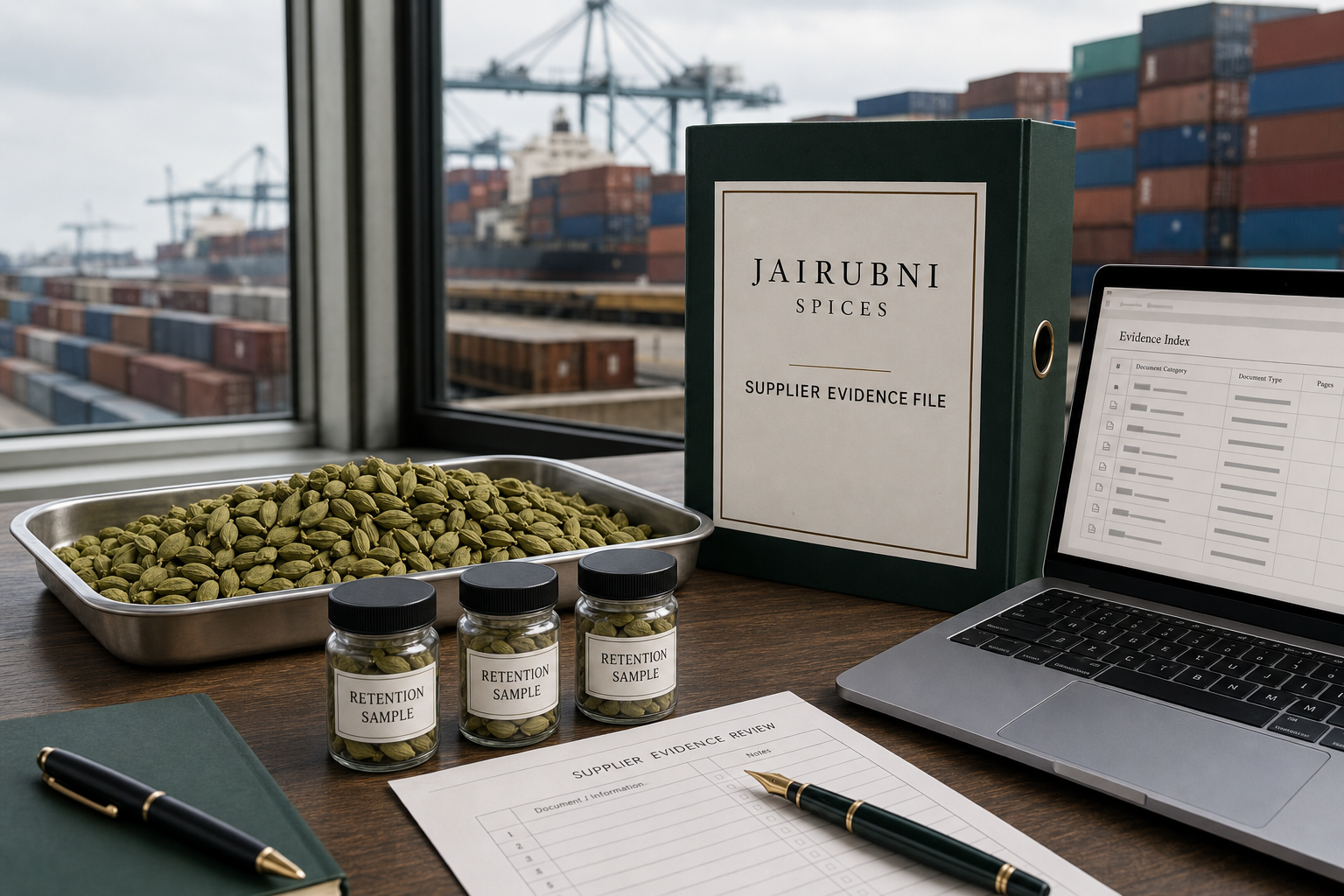
Ask for a coherent, version-controlled file rather than isolated PDFs with no relationship to the quoted product. A useful evidence pack lets the importer trace every claim back to the supplier, site, product, process and lot.
Legal name, production or packing address, contact, role in the supply chain and current facility-registration information shared securely where required.
Whole pods or seeds, grade and size profile, tolerances, moisture, intended use, packaging, storage, shelf life and lot-coding logic.
Process flow from receiving to dispatch, hazard-control points, sanitation, pest control, foreign-material controls and treatment status where applicable.
Lot-linked reports naming methods, results, units, limits, sample identity and laboratory details—not a detached “pass” statement.
Supplier lot, pack dates, input linkage, shipment linkage, retained samples and the contact path for trace, withdrawal or recall support.
Relevant audits, complaints, deviations, regulatory findings where applicable, and evidence that corrective actions were implemented and checked.
For procurement specifications, compare our cardamom quality evaluation guide, commercial grades guide and bulk packaging options. The FSVP file should refer to the same product and pack actually being purchased.
Choose verification that matches the risk
FDA lists onsite audits, sampling and testing, and review of relevant food-safety records among supplier-verification activities. An importer may rely on work performed by another qualified entity, but must review and assess the supporting documentation rather than simply forwarding it into a folder.
Records review
Specify the exact records, period, lot or operation being reviewed, the reviewer, findings and follow-up. A generic certificate with no product or facility scope has limited value.
Sampling and testing
Document the sample source, chain of custody, method, laboratory, acceptance criteria and relationship to the imported lot. Decide in advance what happens when a result is missing, late, atypical or outside specification.
Onsite audit
Use a qualified auditor and a scope that addresses applicable FDA food-safety requirements and the hazards being controlled. Where a foreign supplier controls a hazard for which exposure could result in serious adverse health consequences or death, FDA generally expects an annual onsite audit unless a written determination supports another activity or frequency.
Record who reviewed the evidence, when it was reviewed, whether it was acceptable, any follow-up required and the final supplier-status decision.
Keep FSVP and entry readiness aligned
| Entry control | What to confirm | Why it matters |
|---|---|---|
| Facility registration | Applicable foreign facilities are registered and the correct facility identity is used. The registration’s US agent is distinct from the FSVP importer role. | FDA uses facility information in its import and food-safety systems; registration is not supplier approval. |
| FSVP entry data | Importer name, email address and FDA-recognised Unique Facility Identifier—currently a DUNS number—are accurate for each entry line. | Incorrect or placeholder FSV data can disrupt admission and does not establish an importer programme. |
| Prior Notice | FDA receives and confirms Prior Notice before the food arrives, using the correct manufacturer, product and shipment information. | Imported food is subject to Prior Notice and may be refused or held when requirements are not met. |
| Label and documents | English labelling and commercial documents accurately describe the product, origin, lot, quantity, parties and intended use. | Imported food must be safe, sanitary and truthfully labelled in accordance with US requirements. |
The minimum approval dossier
Use the dossier as a control index. The importer’s qualified individual decides which documents and verification activities are actually required.
Pause approval when the evidence does not connect
Primary FDA sources reviewed
- FSVP Final Rule: key requirements — importer definition, hazard evaluation, supplier verification, corrective action and entry identification.
- FDA Foreign Supplier Verification Programs guidance for industry — written procedures, verification activities, review and documentation.
- Importing food products into the United States — importer responsibilities, registration, Prior Notice and FDA admission controls.
- Prior Notice of imported foods — filing requirement and submission systems.
- Questions and answers on improving the safety of spices and the associated FDA spice risk profile.
- FDA’s July 2026 facility-registration security reminder — protecting registration PINs and account credentials.